
How Shuttering Plywood Is Actually Made — A Look Inside Our Factory
Most people who buy shuttering plywood have never seen one being made. They judge a board by its brown film and its price, and that is it. But the things that decide whether a board lasts 5 pours or 15 happen long before the film goes on — inside the factory, on machines most buyers never hear about. We have been making plywood in Sitapur since 1948, so let us walk you through what actually happens to a log before it becomes a sheet you can trust on site.
It starts with the log, not the film
A shuttering board is only as good as the wood inside it. Before anything else, logs are sorted and the timber that goes into the core is selected by hand. This is the first place where cheap boards quietly cut corners — soft, light timber goes in, the board feels lighter, and it dents under concrete pressure later. A heavier board usually means a denser, harder core, and that starts right here at log selection.
Hamari shuttering plywood ka core eucalyptus (safeda) hardwood ka banta hai — ek dense, majboot lakdi jo concrete ka wajan behtar sehti hai aur board ko zyada baar reusable banati hai.
Peeling — turning a round log into a flat sheet
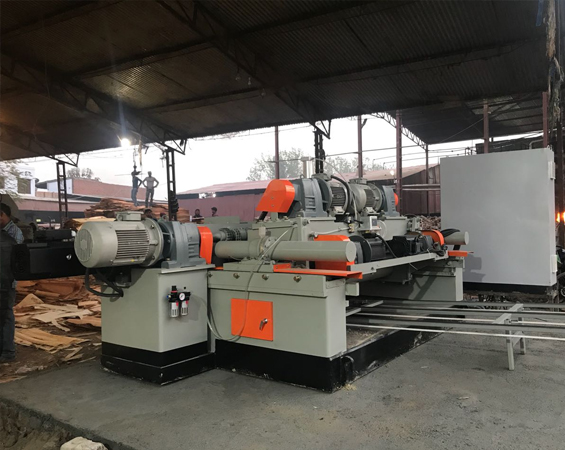
The log is mounted on the peeling machine (a rotary lathe). As the log spins, a long blade shaves off one continuous thin ribbon of wood — like unrolling a roll of tape. This ribbon is the veneer, and getting it right matters more than people think. If the blade pressure or the thickness is even slightly off, the veneer comes out uneven, and that unevenness shows up later as weak spots in the board.
A good peeling machine gives a continuous ribbon of uniform thickness. That single word — uniform — is what separates a clean board from a wavy one.
The core dryer — where most failures are prevented
This is the machine almost no buyer thinks about, and it is the most important one for a waterproof board. Freshly peeled veneer is full of moisture. If you press it while it is still damp, the glue never bonds properly, and the board will bubble or delaminate the first time it meets wet concrete.
The core dryer removes that moisture in a controlled way before the veneers ever reach the glue line. Get this step wrong and it does not matter how good your glue is — the board is already weak. Get it right, and you have given the board its best chance to survive years of reuse.
Glue spreading — the part you can't see but always pay for
Now the dried veneers are coated with adhesive and stacked, each layer's grain running across the one below it. That cross-grain stacking is what gives plywood its strength in both directions. For shuttering work, the adhesive has to be 100% phenolic (PF) resin — this is what makes a board BWP (Boiling Water Proof) instead of just moisture resistant. Phenolic costs more than the cheaper urea glue, and this is exactly where economy boards save money and where they later fail in water.
The hot press — where it all becomes one board
The stacked, glued veneers go into the hot press. Under high heat and heavy pressure, the layers fuse into a single solid panel and the phenolic resin cures into a bond that water cannot easily break. This is the heart of the whole process. Press time, temperature and pressure all have to be correct — too little and the bond is weak, too much and the board can scorch or warp.
When people ask why one board survives 15 pours and another splits after four, the honest answer is usually: what happened in the hot press, and whether the core was properly dried before it got there.
Drum sander and finishing — the part the buyer finally sees
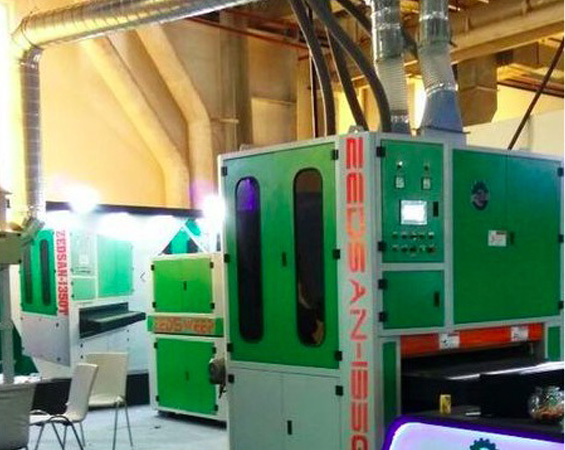
After pressing, the board passes through the drum sander, which sands both faces to an even, calibrated thickness. A board sold as "18mm" should actually be 18mm across the whole sheet — the sander is what makes that true. Then the film is applied and the edges are sealed, which protects the board from soaking up water from the cut sides.
Why this whole story matters when you buy
Two boards can look identical on a shop floor and behave completely differently on site — because everything that makes the difference is invisible by the time you see the finished sheet. When you understand the process, you stop buying on film and price alone, and you start asking the right questions: Is the core hardwood? Is it properly dried? Is the glue real phenolic? Is the thickness honest?
That is also why a direct manufacturer relationship is worth more than a slightly cheaper unbranded board. You are not just buying plywood — you are buying every one of these steps being done properly, batch after batch.
Want shuttering plywood where every step above is done right?
Southwest Plywood (part of Krishna Plywood Industry) has been manufacturing BWP-grade film faced shuttering plywood in Sitapur, UP since 1948. Dealer and distributor enquiries welcome — visit our plant or test a sample before you order.
Call +91 9873839759 WhatsApp Us See Our Infrastructure